ADPF 54 is a landmark case of the Supreme Court of Brazil. The minister relator Marco Aurélio Mello voted in favor of decriminalization of abortions involving anencephalic fetuses.
High Court decision
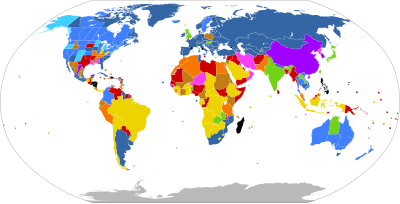
| Legal on request: |
|
| No gestational limit |
|
| Gestational limit after the first 17 weeks |
|
| Gestational limit in the first 17 weeks |
|
| Unclear gestational limit |
| Legally restricted to cases of: |
|
|
Risk to woman's life, to her health*, rape*, fetal impairment*, or socioeconomic factors |
|
| Risk to woman's life, to her health*, rape, or fetal impairment |
|
| Risk to woman's life, to her health*, or fetal impairment |
|
| Risk to woman's life*, to her health*, or rape |
|
| Risk to woman's life or to her health |
|
| Risk to woman's life |
|
| Illegal with no exceptions |
|
| No information |
| * Does not apply to some countries or territories in that category |
Note: In some countries or territories, abortion laws are modified by other laws,
regulations,
legal principles or
judicial decisions. This map shows their combined effect as implemented by the authorities.
Judiciary representation
Legislative representation
Executive representation
Amici curiae
|
Amici curiae (Support for ADPF 54) (11)
|
|---|
| Anis (Institute of Bioethics, Human Rights and Gender)
|
Adef (Association of Family Development)
|
Federal Council of Medicine
|
Federal Deputy José Pinotti (DEM-SP)
|
School of People and National Feminist Network of Health, Sexual and Reproductive Rights
|
Brazilian Federation of Gynecology
|
Brazilian Federation of Obstetrics
|
Brazilian Society of Clinical Genetics
|
Brazilian Clinical Society of Fetal Medicine
|
Brazilian Clinical Society for the Progress of Science
|
Catholics for the Right to Decide (CDD) |
See also
|
|
|---|
| Civil liberties |
|
| Family law |
|
| Politics and government |
|
| Other |
|