| AP4S1 |
|---|
|
| Identifiers |
|---|
| Aliases |
AP4S1, AP47B, CLA20, CLAPS4, CPSQ6, SPG52, adaptor related protein complex 4 sigma 1 subunit, adaptor related protein complex 4 subunit sigma 1 |
| External IDs |
OMIM: 607243 MGI: 1337065 HomoloGene: 32513 GeneCards: AP4S1 |
|
| Gene location (Mouse) |
|---|
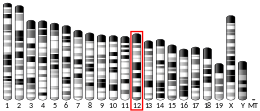 |
| Chr. |
Chromosome 12 (mouse) |
|
| Band |
12|12 B3 |
Start |
51,737,816 bp |
| End |
51,791,569 bp |
|
|
RNA expression pattern |
|---|
| Bgee |
| Human |
Mouse (ortholog) |
| Top expressed in |
- endothelial cell
- Achilles tendon
- Brodmann area 23
- middle temporal gyrus
- prefrontal cortex
- Brodmann area 9
- corpus callosum
- cingulate gyrus
- germinal epithelium
- nucleus accumbens
|
|
| Top expressed in |
- intercostal muscle
- temporal muscle
- extensor digitorum longus muscle
- plantaris muscle
- sternocleidomastoid muscle
- interventricular septum
- digastric muscle
- triceps brachii muscle
- right ventricle
- myocardium of ventricle
|
|
| More reference expression data |
|
| BioGPS |
|
|
|
| Wikidata |
|
AP-4 complex subunit sigma-1 is a protein that in humans is encoded by the AP4S1 gene.
Function
The heterotetrameric adaptor protein (AP) complexes sort integral membrane proteins at various stages of the endocytic and secretory pathways. AP4 is composed of 2 large chains, beta-4 (AP4B1) and epsilon-4 (AP4E1), a medium chain, mu-4 (AP4M1), and a small chain, sigma-4 (AP4S1, this gene).
Clinical relevance
Deficiency of AP-4 leads to childhood-onset hereditary spastic paraplegia and it is currently hypothesized that AP4-complex-mediated trafficking plays a crucial role in brain development and functioning.
See also
External links
Further reading