

| |

| |
| |
| Names | |
|---|---|
| Other names
bromine(I) chloride
bromochloride bromine chloride | |
| Identifiers | |
|
3D model (JSmol)
|
|
| ChemSpider | |
| ECHA InfoCard | 100.034.169 |
| EC Number |
|
|
PubChem CID
|
|
| RTECS number |
|
| UNII | |
| UN number | 2901 |
|
CompTox Dashboard (EPA)
|
|
| |
| |
| Properties | |
| BrCl | |
| Molar mass | 115.357 g/mol |
| Density | 2.172 g/cm3 |
| Melting point | −54 °C (−65 °F; 219 K) |
| Boiling point | 5 °C (41 °F; 278 K) |
| Solubility in water | 8.5 g/L |
| Hazards | |
| NFPA 704 (fire diamond) | |
|
Except where otherwise noted, data are given for materials in their standard state (at 25 °C [77 °F], 100 kPa).
| |


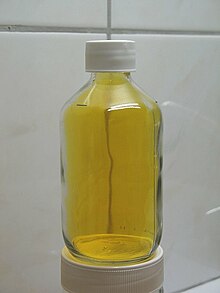
Bromine monochloride, also called bromine(I) chloride, bromochloride, and bromine chloride, is an interhalogen inorganic compound with chemical formula BrCl. It is a very reactive golden yellow gas with boiling point 5 °C and melting point −66 °C. Its CAS number is 13863-41-7, and its EINECS number is 237-601-4. It is a strong oxidizing agent.
Uses
Bromine monochloride is used in analytical chemistry in determining low levels of mercury, to quantitatively oxidize mercury in the sample to Hg(II) state.
A common use of bromine monochloride is as an algaecide, fungicide, and disinfectant of industrial recirculating cooling water systems.
Addition of bromine monochloride is used in some types of Li-SO2 batteries to increase voltage and energy density.