
 | |
 | |
| Clinical data | |
|---|---|
| Trade names | Hypnazol, Eudormil, Viodor |
| Other names | Fenadiazol; Fenadiazolum; Fenodiazole; Phénadiazole; Phenadiazole; JL-512; J. L. 512; NSC-100729; 2-(o-Hydroxyphenyl)-1,3,4-oxadiazole; 2-(2-Hydroxyphenyl)-1,3,4-oxadiazole; o-1,3,4-Oxadiazol-2-ylphenol |
| Routes of administration |
By mouth |
| ATC code |
|
| Identifiers | |
| |
| CAS Number | |
| PubChem CID | |
| ChemSpider | |
| UNII | |
| ChEBI | |
| ChEMBL | |
| CompTox Dashboard (EPA) | |
| ECHA InfoCard | 100.206.148 |
| Chemical and physical data | |
| Formula | C8H6N2O2 |
| Molar mass | 162.148 g·mol−1 |
| 3D model (JSmol) | |
| |
| |
| (verify) | |


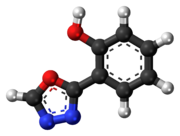
Fenadiazole (INN), also known as phénadiazole (DCF) and sold under the brand names Hypnazol, Eudormil, and Viodor, is a hypnotic and sedative medication which has been used to treat insomnia but is no longer marketed. It is described as a non-barbiturate hypnotic with marked or profound hypnotic and sedative properties in animals, variable hypnotic effects in humans (rapidly inducing sleep for 6 to 8 hours), additional anticonvulsant, antithermal, and spasmolytic effects, and a generally well-tolerated profile in humans (at an average dosage of 200 mg/day). The drug was synthesized, pharmacologically characterized, patented, and marketed by the French pharmaceutical company Laboratoires Jacques Logeais between 1960 and 1962. As a hypnotic and sedative, fenadiazole has a unique oxadiazole-based chemical structure. It may be chemically related to certain other hypnotics and sedatives with atypical chemical structures.