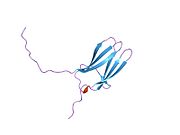

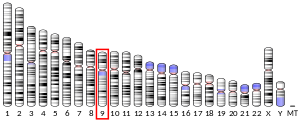





Tropomyosin receptor kinase B (TrkB), also known as tyrosine receptor kinase B, or BDNF/NT-3 growth factors receptor or neurotrophic tyrosine kinase, receptor, type 2 is a protein that in humans is encoded by the NTRK2 gene. TrkB is a receptor for brain-derived neurotrophic factor (BDNF). Standard pronunciation is "track bee".
Function
Tropomyosin receptor kinase B is the high affinity catalytic receptor for several "neurotrophins", which are small protein growth factors that induce the survival and differentiation of distinct cell populations. The neurotrophins that activate TrkB are: BDNF (Brain Derived Neurotrophic Factor), neurotrophin-4 (NT-4), and neurotrophin-3 (NT-3). As such, TrkB mediates the multiple effects of these neurotrophic factors, which includes neuronal differentiation and survival. Research has shown that activation of the TrkB receptor can lead to down regulation of the KCC2 chloride transporter in cells of the CNS. In addition to the role of the pathway in neuronal development, BDNF signaling is also necessary for proper astrocyte morphogenesis and maturation, via the astrocytic TrkB.T1 isoform.
The TrkB receptor is part of the large family of receptor tyrosine kinases. A "tyrosine kinase" is an enzyme which is capable of adding a phosphate group to certain tyrosines on target proteins, or "substrates". A receptor tyrosine kinase is a "tyrosine kinase" which is located at the cellular membrane, and is activated by binding of a ligand to the receptor's extracellular domain. Other examples of tyrosine kinase receptors include the insulin receptor, the IGF1 receptor, the MuSK protein receptor, the Vascular Endothelial Growth Factor (or VEGF) receptor, etc.

Currently, there are three TrkB isoforms in the mammalian CNS. The full-length isoform (TK+) is a typical tyrosine kinase receptor, and transduces the BDNF signal via Ras-ERK, PI3K, and PLCγ. In contrast, two truncated isoforms (TK-: T1 and T2) possess the same extracellular domain, transmembrane domain, and first 12 intracellular amino acid sequences as TK+. However, the C-terminal sequences are the isoform-specific (11 and 9 amino acids, respectively). T1 has the original signaling cascade that is involved in the regulation of cell morphology and calcium influx.
Family members
TrkB is part of a sub-family of protein kinases which includes also TrkA and TrkC. There are other neurotrophic factors structurally related to BDNF: NGF (for Nerve Growth Factor), NT-3 (for Neurotrophin-3) and NT-4 (for Neurotrophin-4). While TrkB mediates the effects of BDNF, NT-4 and NT-3, TrkA is bound and thereby activated only by NGF. Further, TrkC binds and is activated by NT-3.
TrkB binds BDNF and NT-4 more strongly than it binds NT-3. TrkC binds NT-3 more strongly than TrkB does.
LNGFR
There is one other BDNF receptor besides TrkB, called the "LNGFR" (for "low-affinity nerve growth factor receptor"). Unlike TrkB, the LNGFR plays a somewhat less clear role in BDNF biology. Some researchers have shown the LNGFR binds and serves as a "sink" for neurotrophins. Cells which express both the LNGFR and the Trk receptors might therefore have a greater activity – since they have a higher "microconcentration" of the neurotrophin. It has also been shown, however, that the LNGFR may signal a cell to die via apoptosis – so therefore cells expressing the LNGFR in the absence of Trk receptors may die rather than live in the presence of a neurotrophin. The LNGFR is not required for BDNF to activate TrkB.
Role in cancer
Although originally identified as an oncogenic fusion in 1982, only recently has there been a renewed interest in the Trk family as it relates to its role in human cancers because of the identification of NTRK1 (TrkA), NTRK2 (TrkB) and NTRK3 (TrkC) gene fusions and other oncogenic alterations in a number of tumor types. A number of Trk inhibitors are (in 2015) in clinical trials and have shown early promise in shrinking human tumors.
Role in Neurodegeneration
TrkB and its ligand BDNF have been associated to both normal brain function and in the pathology and progression of Alzheimer’s disease (AD) and other neurodegenerative disorders. First of all, BDNF/TrkB signalling has been implicated in long-term memory formation, the regulation of long-term potentiation, as well as hippocampal synaptic plasticity. In particular, neuronal activity has been shown to lead to an increase in TrkB mRNA transcription, as well as changes in TrkB protein trafficking, including receptor endocytosis or translocation. Both TrkB and BDNF are downregulated in the brain of early AD patients with mild cognitive impairments, while work in mice has shown that reducing TrkB levels in the brain of AD mouse models leads to a significant increase in memory deficits. In addition, combining the induction of adult hippocampal neurogenesis and increasing BDNF levels lead to an improved cognition, mimicking exercise benefits in AD mouse models. The effect of TrkB/BDNF signalling on AD pathology has been shown to be in part mediated by an increase in δ-secretase levels, via an upregulation of the JAK2/STAT3 pathway and C/EBPβ downstream of TrkB. Additionally, TrkB has been shown to reduce amyloid-β production by APP binding and phosphorylation, while TrkB cleavage by δ-secretase blocks normal TrkB activity. Dysregulation of the TrkB/BDNF pathway has been implicated in other neurological and neurodegenerative conditions, including stroke, Huntington’s Disease, Parkinson’s Disease, Amyotrophic lateral schlerosis and stress-related disorders.(Notaras and van den Buuse, 2020; Pradhan et al., 2019; Tejeda and Díaz-Guerra, 2017).
As a drug target
Entrectinib (formerly RXDX-101) is an investigational drug developed by Ignyta, Inc., which has potential antitumor activity. It is a selective pan-trk receptor tyrosine kinase inhibitor (TKI) targeting gene fusions in trkA, trkB (this gene), and trkC (respectively, coded by NTRK1, NTRK2, and NTRK3 genes) that is currently in phase 2 clinical testing. In addition, TrkB/BDNF signalling has been the target for developing novel drugs for Alzheimer’s Disease, Parkinson’s Disease or other neurodegenerative and psychiatric disorders, aiming at either pharmacological modulation of the pathway (e.g. small molecule mimetics) or other means (e.g. exercise induced changes in TrkB signalling).
Ligands
Agonists
- 3,7-Dihydroxyflavone
- 3,7,8,2'-Tetrahydroxyflavone
- 7,3′-Dihydroxyflavone
- 7,8,2'-Trihydroxyflavone
- 7,8,3'-Trihydroxyflavone
- Amitriptyline
- BNN-20
- Brain-derived neurotrophic factor (BDNF)
- Deoxygedunin
- Deprenyl
- Diosmetin
- DMAQ-B1
- Eutropoflavin (4'-DMA-7,8-DHF)
- HIOC
- LM22A-4
- N-Acetylserotonin (NAS)
- Neurotrophin-3 (NT-3)
- Neurotrophin-4 (NT-4)
- Norwogonin (5,7,8-THF)
- R7 (prodrug of tropoflavin)
- R13 (prodrug of tropoflavin)
- TDP6
- Tropoflavin (7,8-DHF)
Antagonists
- ANA-12
- Cyclotraxin B
- Gossypetin (3,5,7,8,3',4'-HHF)
Others
Interactions
TrkB has been shown to interact with:
- Brain-derived neurotrophic factor (BDNF),
- FYN,
- NCK2,
- PLCG1,
- Sequestosome 1, and
- SHC3.
See also
Further reading
- Klein R, Conway D, Parada LF, Barbacid M (May 1990). "The trkB tyrosine protein kinase gene codes for a second neurogenic receptor that lacks the catalytic kinase domain". Cell. 61 (4): 647–656. doi:10.1016/0092-8674(90)90476-U. PMID 2160854. S2CID 205020147.
- Squinto SP, Stitt TN, Aldrich TH, Davis S, Bianco SM, Radziejewski C, et al. (May 1991). "trkB encodes a functional receptor for brain-derived neurotrophic factor and neurotrophin-3 but not nerve growth factor". Cell. 65 (5): 885–893. doi:10.1016/0092-8674(91)90395-F. PMID 1710174. S2CID 28853455.
- Rose CR, Blum R, Pichler B, Lepier A, Kafitz KW, Konnerth A (November 2003). "Truncated TrkB-T1 mediates neurotrophin-evoked calcium signalling in glia cells". Nature. 426 (6962): 74–78. Bibcode:2003Natur.426...74R. doi:10.1038/nature01983. PMID 14603320. S2CID 4432074.
- Ohira K, Kumanogoh H, Sahara Y, Homma KJ, Hirai H, Nakamura S, Hayashi M (February 2005). "A truncated tropomyosin-related kinase B receptor, T1, regulates glial cell morphology via Rho GDP dissociation inhibitor 1". The Journal of Neuroscience. 25 (6): 1343–1353. doi:10.1523/JNEUROSCI.4436-04.2005. PMC 6725989. PMID 15703388.
- Yamada K, Nabeshima T (April 2003). "Brain-derived neurotrophic factor/TrkB signaling in memory processes". Journal of Pharmacological Sciences. 91 (4): 267–270. doi:10.1254/jphs.91.267. PMID 12719654.
- Soppet D, Escandon E, Maragos J, Middlemas DS, Reid SW, Blair J, et al. (May 1991). "The neurotrophic factors brain-derived neurotrophic factor and neurotrophin-3 are ligands for the trkB tyrosine kinase receptor". Cell. 65 (5): 895–903. doi:10.1016/0092-8674(91)90396-G. PMID 1645620. S2CID 37843818.
- Squinto SP, Stitt TN, Aldrich TH, Davis S, Bianco SM, Radziejewski C, et al. (May 1991). "trkB encodes a functional receptor for brain-derived neurotrophic factor and neurotrophin-3 but not nerve growth factor". Cell. 65 (5): 885–893. doi:10.1016/0092-8674(91)90395-F. PMID 1710174. S2CID 28853455.
- Haniu M, Talvenheimo J, Le J, Katta V, Welcher A, Rohde MF (September 1995). "Extracellular domain of neurotrophin receptor trkB: disulfide structure, N-glycosylation sites, and ligand binding". Archives of Biochemistry and Biophysics. 322 (1): 256–264. doi:10.1006/abbi.1995.1460. PMID 7574684.
- Ip NY, Stitt TN, Tapley P, Klein R, Glass DJ, Fandl J, et al. (February 1993). "Similarities and differences in the way neurotrophins interact with the Trk receptors in neuronal and nonneuronal cells". Neuron. 10 (2): 137–149. doi:10.1016/0896-6273(93)90306-C. PMID 7679912. S2CID 46072027.
- Slaugenhaupt SA, Blumenfeld A, Liebert CB, Mull J, Lucente DE, Monahan M, et al. (February 1995). "The human gene for neurotrophic tyrosine kinase receptor type 2 (NTRK2) is located on chromosome 9 but is not the familial dysautonomia gene". Genomics. 25 (3): 730–732. doi:10.1016/0888-7543(95)80019-I. PMID 7759111.
- Shelton DL, Sutherland J, Gripp J, Camerato T, Armanini MP, Phillips HS, et al. (January 1995). "Human trks: molecular cloning, tissue distribution, and expression of extracellular domain immunoadhesins". The Journal of Neuroscience. 15 (1 Pt 2): 477–491. doi:10.1523/JNEUROSCI.15-01-00477.1995. PMC 6578290. PMID 7823156.
- Allen SJ, Dawbarn D, Eckford SD, Wilcock GK, Ashcroft M, Colebrook SM, et al. (June 1994). "Cloning of a non-catalytic form of human trkB and distribution of messenger RNA for trkB in human brain". Neuroscience. 60 (3): 825–834. doi:10.1016/0306-4522(94)90507-X. PMID 7936202. S2CID 29288978.
- Rydén M, Ibáñez CF (March 1996). "Binding of neurotrophin-3 to p75LNGFR, TrkA, and TrkB mediated by a single functional epitope distinct from that recognized by trkC". The Journal of Biological Chemistry. 271 (10): 5623–5627. doi:10.1074/jbc.271.10.5623. PMID 8621424.
- Yamamoto M, Sobue G, Yamamoto K, Terao S, Mitsuma T (August 1996). "Expression of mRNAs for neurotrophic factors (NGF, BDNF, NT-3, and GDNF) and their receptors (p75NGFR, trkA, trkB, and trkC) in the adult human peripheral nervous system and nonneural tissues". Neurochemical Research. 21 (8): 929–938. doi:10.1007/BF02532343. PMID 8895847. S2CID 20559271.
- Valent A, Danglot G, Bernheim A (1997). "Mapping of the tyrosine kinase receptors trkA (NTRK1), trkB (NTRK2) and trkC(NTRK3) to human chromosomes 1q22, 9q22 and 15q25 by fluorescence in situ hybridization". European Journal of Human Genetics. 5 (2): 102–104. doi:10.1159/000484742. PMID 9195161.
- Haniu M, Montestruque S, Bures EJ, Talvenheimo J, Toso R, Lewis-Sandy S, et al. (October 1997). "Interactions between brain-derived neurotrophic factor and the TRKB receptor. Identification of two ligand binding domains in soluble TRKB by affinity separation and chemical cross-linking". The Journal of Biological Chemistry. 272 (40): 25296–25303. doi:10.1074/jbc.272.40.25296. PMID 9312147.
- Nakamura T, Muraoka S, Sanokawa R, Mori N (March 1998). "N-Shc and Sck, two neuronally expressed Shc adapter homologs. Their differential regional expression in the brain and roles in neurotrophin and Src signaling". The Journal of Biological Chemistry. 273 (12): 6960–6967. doi:10.1074/jbc.273.12.6960. PMID 9507002.
- Hackett SF, Friedman Z, Freund J, Schoenfeld C, Curtis R, DiStefano PS, Campochiaro PA (April 1998). "A splice variant of trkB and brain-derived neurotrophic factor are co-expressed in retinal pigmented epithelial cells and promote differentiated characteristics". Brain Research. 789 (2): 201–212. doi:10.1016/S0006-8993(97)01440-6. PMID 9573364. S2CID 1814445.
- Iwasaki Y, Gay B, Wada K, Koizumi S (July 1998). "Association of the Src family tyrosine kinase Fyn with TrkB". Journal of Neurochemistry. 71 (1): 106–111. doi:10.1046/j.1471-4159.1998.71010106.x. PMID 9648856. S2CID 9012343.
- Qian X, Riccio A, Zhang Y, Ginty DD (November 1998). "Identification and characterization of novel substrates of Trk receptors in developing neurons". Neuron. 21 (5): 1017–1029. doi:10.1016/S0896-6273(00)80620-0. PMID 9856458. S2CID 12354383.
- Bibel M, Hoppe E, Barde YA (February 1999). "Biochemical and functional interactions between the neurotrophin receptors trk and p75NTR". The EMBO Journal. 18 (3): 616–622. doi:10.1093/emboj/18.3.616. PMC 1171154. PMID 9927421.
- Yamada M, Ohnishi H, Sano S, Araki T, Nakatani A, Ikeuchi T, Hatanaka H (July 1999). "Brain-derived neurotrophic factor stimulates interactions of Shp2 with phosphatidylinositol 3-kinase and Grb2 in cultured cerebral cortical neurons". Journal of Neurochemistry. 73 (1): 41–49. doi:10.1046/j.1471-4159.1999.0730041.x. PMID 10386953. S2CID 25333848.
- Ultsch MH, Wiesmann C, Simmons LC, Henrich J, Yang M, Reilly D, et al. (July 1999). "Crystal structures of the neurotrophin-binding domain of TrkA, TrkB and TrkC". Journal of Molecular Biology. 290 (1): 149–159. doi:10.1006/jmbi.1999.2816. PMID 10388563.
External links
- Memories are made of this molecule - New Scientist, 15 January 2007.
|
PDB gallery
| |
|---|---|
|