Isovaleramide
|
|
| Names
|
|---|
|
Preferred IUPAC name
|
| Other names
Isopentanamide
Isovaleric acid amide
Isovaleric amide
beta-Methylbutyramide
|
| Identifiers
|
|---|
|
|
|
|
|
|
|
ChemSpider
|
|
|
ECHA InfoCard
|
100.007.984
|
|
EC Number
|
|
|
KEGG
|
|
|
|
|
|
UNII
|
|
|
|
|
InChI=1S/C5H11NO/c1-4(2)3-5(6)7/h4H,3H2,1-2H3,(H2,6,7)  N N
Key: SANOUVWGPVYVAV-UHFFFAOYSA-N N
InChI=1/C5H11NO/c1-4(2)3-5(6)7/h4H,3H2,1-2H3,(H2,6,7)
Key: SANOUVWGPVYVAV-UHFFFAOYAT
|
|
|
| Properties
|
|---|
|
|
C5H11NO
|
|
Molar mass
|
101.149 g·mol−1
|
| Appearance
|
colourless solid
|
|
Melting point
|
137 °C (279 °F; 410 K)
|
|
Boiling point
|
226 °C (439 °F; 499 K)
|
Except where otherwise noted, data are given for materials in their standard state (at 25 °C [77 °F], 100 kPa). |
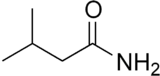
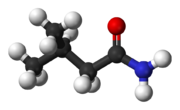
Isovaleramide is an organic compound with the formula (CH3)2CHCH2C(O)NH2. The amide derived from isovaleric acid, it is a colourless solid.
Occurrence and biological activity
Isovaleramide is a constituent of valerian root.
In humans, it acts as a mild anxiolytic at lower doses and as a mild sedative at higher dosages. Isovaleramide has been shown to be non-cytotoxic and does not act as a CNS stimulant. It inhibits the liver alcohol dehydrogenases and has a reported LD50 of greater than 400 mg/kg when administered intraperitoneally in mice.
It is a positive allosteric modulator of the GABAA receptor, similarly to isovaleric acid.
|
|
|---|
| Alcohols |
|
| Barbiturates |
|
| Benzodiazepines |
|
| Carbamates |
|
| Flavonoids |
|
| Imidazoles |
|
|
Kava constituents |
|
| Monoureides |
|
| Neuroactive steroids |
|
| Nonbenzodiazepines |
|
| Phenols |
|
| Piperidinediones |
|
| Pyrazolopyridines |
|
| Quinazolinones |
|
|
Volatiles/gases
|
|
| Others/unsorted |
- 3-Hydroxybutanal
- α-EMTBL
- AA-29504
- Alogabat
-
Avermectins (e.g., ivermectin)
-
Bromide compounds (e.g., lithium bromide, potassium bromide, sodium bromide)
- Carbamazepine
- Chloralose
- Chlormezanone
- Clomethiazole
- Darigabat
- DEABL
- Deuterated etifoxine
-
Dihydroergolines (e.g., dihydroergocryptine, dihydroergosine, dihydroergotamine, ergoloid (dihydroergotoxine))
- DS2
- Efavirenz
- Etazepine
- Etifoxine
-
Fenamates (e.g., flufenamic acid, mefenamic acid, niflumic acid, tolfenamic acid)
- Fluoxetine
- Flupirtine
- Hopantenic acid
- KRM-II-81
- Lanthanum
- Lavender oil
-
Lignans (e.g., 4-O-methylhonokiol, honokiol, magnolol, obovatol)
- Loreclezole
- Menthyl isovalerate (validolum)
- Monastrol
- Niacin
- Niacinamide
- Org 25,435
- Phenytoin
- Propanidid
- Retigabine (ezogabine)
- Safranal
- Seproxetine
- Stiripentol
-
Sulfonylalkanes (e.g., sulfonmethane (sulfonal), tetronal, trional)
-
Terpenoids (e.g., borneol)
- Topiramate
-
Valerian constituents (e.g., isovaleric acid, isovaleramide, valerenic acid, valerenol)
|
|