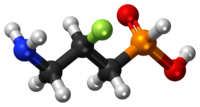
Lesogaberan

|
|
| Names
|
|---|
Preferred IUPAC name
[(2R)-3-Amino-2-fluoropropyl]phosphinic acid |
| Other names
AZD-3355
|
| Identifiers
|
|---|
|
|
|
|
|
|
|
ChEMBL
|
|
|
ChemSpider
|
|
|
ECHA InfoCard
|
100.133.162
|
|
|
|
|
|
|
|
UNII
|
|
|
|
|
InChI=1S/C3H9FNO2P/c4-3(1-5)2-8(6)7/h3,8H,1-2,5H2,(H,6,7)/t3-/m1/s1  N N
Key: LJNUIEQATDYXJH-GSVOUGTGSA-N N
InChI=1/C3H9FNO2P/c4-3(1-5)2-8(6)7/h3,8H,1-2,5H2,(H,6,7)/t3-/m1/s1
Key: LJNUIEQATDYXJH-GSVOUGTGBQ
|
|
|
| Properties
|
|---|
|
|
C3H9FNO2P
|
|
Molar mass
|
141.082 g·mol−1
|
Except where otherwise noted, data are given for materials in their standard state (at 25 °C [77 °F], 100 kPa). |
Lesogaberan (AZD-3355) was an experimental drug candidate developed by AstraZeneca for the treatment of gastroesophageal reflux disease (GERD). As a GABAB receptor agonist, it has the same mechanism of action as baclofen, but is anticipated to have fewer of the central nervous system side effects that limit the clinical use of baclofen for the treatment of GERD.
|
|
|---|
| Ionotropic |
| GABAA |
-
Positive modulators (abridged; see here for a full list): α-EMTBL
-
Alcohols (e.g., drinking alcohol, 2M2B)
- Anabolic steroids
-
Avermectins (e.g., ivermectin)
-
Barbiturates (e.g., phenobarbital)
-
Benzodiazepines (e.g., diazepam)
-
Bromide compounds (e.g., potassium bromide)
-
Carbamates (e.g., meprobamate)
- Carbamazepine
- Chloralose
- Chlormezanone
- Clomethiazole
-
Dihydroergolines (e.g., ergoloid (dihydroergotoxine))
- Etazepine
- Etifoxine
-
Fenamates (e.g., mefenamic acid)
-
Flavonoids (e.g., apigenin, hispidulin)
- Fluoxetine
- Flupirtine
-
Imidazoles (e.g., etomidate)
-
Kava constituents (e.g., kavain)
- Lanthanum
- Loreclezole
- Monastrol
-
Neuroactive steroids (e.g., allopregnanolone, cholesterol, THDOC)
- Niacin
- Niacinamide
-
Nonbenzodiazepines (e.g., β-carbolines (e.g., abecarnil), cyclopyrrolones (e.g., zopiclone), imidazopyridines (e.g., zolpidem), pyrazolopyrimidines (e.g., zaleplon))
- Norfluoxetine
- Petrichloral
-
Phenols (e.g., propofol)
- Phenytoin
-
Piperidinediones (e.g., glutethimide)
- Propanidid
-
Pyrazolopyridines (e.g., etazolate)
-
Quinazolinones (e.g., methaqualone)
- Retigabine (ezogabine)
- ROD-188
-
Skullcap constituents (e.g., baicalin)
- Stiripentol
-
Sulfonylalkanes (e.g., sulfonmethane (sulfonal))
- Topiramate
-
Valerian constituents (e.g., valerenic acid)
-
Volatiles/gases (e.g., chloral hydrate, chloroform, diethyl ether, paraldehyde, sevoflurane)
-
Negative modulators: 1,3M1B
- 3M2B
- 11-Ketoprogesterone
- 17-Phenylandrostenol
- α5IA (LS-193,268)
- β-CCB
- β-CCE
- β-CCM
- β-CCP
- β-EMGBL
- Anabolic steroids
- Amiloride
- Anisatin
-
β-Lactams (e.g., penicillins, cephalosporins, carbapenems)
- Basmisanil
- Bemegride
-
Bicyclic phosphates (TBPS, TBPO, IPTBO)
- BIDN
- Bilobalide
- Bupropion
- CHEB
- Chlorophenylsilatrane
- Cicutoxin
- Cloflubicyne
- Cyclothiazide
- DHEA
- DHEA-S
- Dieldrin
- (+)-DMBB
- DMCM
- DMPC
- EBOB
- Etbicyphat
- FG-7142 (ZK-31906)
-
Fiproles (e.g., fipronil)
-
Flavonoids (e.g., amentoflavone, oroxylin A)
- Flumazenil
-
Fluoroquinolones (e.g., ciprofloxacin)
- Flurothyl
- Furosemide
- Golexanolone
- Iomazenil (123I)
- IPTBO
- Isopregnanolone (sepranolone)
- L-655,708
- Laudanosine
- Leptazol
- Lindane
- MaxiPost
- Morphine
- Morphine-3-glucuronide
- MRK-016
- Naloxone
- Naltrexone
- Nicardipine
-
Nonsteroidal antiandrogens (e.g., apalutamide, bicalutamide, enzalutamide, flutamide, nilutamide)
- Oenanthotoxin
- Pentylenetetrazol (pentetrazol)
- Phenylsilatrane
-
Picrotoxin (i.e., picrotin, picrotoxinin and dihydropicrotoxinin)
- Pregnenolone sulfate
- Propybicyphat
- PWZ-029
- Radequinil
- Ro 15-4513
- Ro 19-4603
- RO4882224
- RO4938581
- Sarmazenil
- SCS
- Suritozole
- TB-21007
- TBOB
- TBPS
- TCS-1105
- Terbequinil
- TETS
- Thujone
- U-93631
- Zinc
- ZK-93426
|
| GABAA-ρ |
|
|
| Metabotropic |
|
|