
Metharbital
Подписчиков: 0, рейтинг: 0
 | |
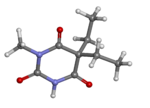 | |
| Clinical data | |
|---|---|
| Other names | Endiemal, metharbitone, methobarbitone |
| Routes of administration |
By mouth (tablets) |
| ATC code | |
| Legal status | |
| Legal status |
|
| Identifiers | |
| |
| CAS Number |
|
| PubChem CID | |
| IUPHAR/BPS | |
| DrugBank |
|
| ChemSpider |
|
| UNII | |
| KEGG |
|
| ChEMBL | |
| CompTox Dashboard (EPA) | |
| ECHA InfoCard | 100.000.011 |
| Chemical and physical data | |
| Formula | C9H14N2O3 |
| Molar mass | 198.222 g·mol−1 |
| 3D model (JSmol) | |
| |
| |
| (verify) | |

Metharbital was patented in 1905 by Emil Fischer working for Merck. It was marketed as Gemonil by Abbott Laboratories. It is a barbiturate anticonvulsant, used in the treatment of epilepsy. It has similar properties to phenobarbital.
History
- 1952 Gemonil was introduced by Abbott Laboratories.
- 1990 Abbott stopped marketing.
Synthesis
Metharbital can be synthesized from 2,2-diethylmalonic acid and O-methylisourea.
| Alcohols | |
|---|---|
| Barbiturates |
|
| Benzodiazepines |
|
| Carbamates | |
| Flavonoids |
|
| Imidazoles | |
| Kava constituents | |
| Monoureides | |
| Neuroactive steroids |
|
| Nonbenzodiazepines | |
| Phenols | |
| Piperidinediones | |
| Pyrazolopyridines | |
| Quinazolinones | |
| Volatiles/gases |
|
| Others/unsorted |
|