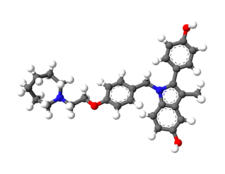
Bazedoxifene, used as bazedoxifene acetate, is a medication for bone problems and possibly (pending more study) for cancer. It is a third-generation selective estrogen receptor modulator (SERM). Since late 2013 it has had U.S. FDA approval for bazedoxifene as part of the combination drug Duavee in the prevention (not treatment) of postmenopausal osteoporosis. It is also being studied for possible treatment of breast cancer and pancreatic cancer.
Medical uses
Bazedoxifene is used in the treatment of postmenopausal osteoporosis.
Available forms
Bazedoxifene is marketed both alone and in combination with conjugated estrogens.
Pharmacology
Pharmacodynamics
Bazedoxifene is a selective estrogen receptor modulator (SERM), or a mixed agonist and antagonist of the estrogen receptor (ER) in different tissues.
Chemistry
The drug is a member of the 2-phenylindole group of SERMs, along with zindoxifene and pipendoxifene.
History
Development
Bazedoxifene was developed by Pfizer following the completion of their takeover of Wyeth Pharmaceuticals. It is the result of an exclusive research collaboration between Wyeth Pharmaceuticals and Ligand Pharmaceuticals.
Approval
The drug was approved in the European Union by the European Medicines Agency on April 27, 2009.
On October 3, 2013, the FDA approved the combination product of bazedoxifene 20 mg with 0.45 mg Premarin (conjugated estrogens) for the treatment of menopausal osteoporosis and the treatment of moderate to severe hot flushes. This is the first approved menopausal hormone therapy product that contains a SERM (bazedoxifene) and an estrogen.
Society and culture
Brand names
Bazedoxifene is marketed alone under the brand names Conbriza and Viviant and in combination with conjugated estrogens under the brand names Duavee and Duavive.
See also
|
|
|---|
| Estrogens |
|
ER agonists |
-
Steroidal: Alfatradiol
- Certain androgens/anabolic steroids (e.g., testosterone, testosterone esters, methyltestosterone, metandienone, nandrolone esters) (via estrogenic metabolites)
- Certain progestins (e.g., norethisterone, noretynodrel, etynodiol diacetate, tibolone)
- Clomestrone
- Cloxestradiol acetate
- Conjugated estriol
- Conjugated estrogens
- Epiestriol
- Epimestrol
- Esterified estrogens
-
Estetrol†
- Estradiol
-
Estradiol esters (e.g., estradiol acetate, estradiol benzoate, estradiol cypionate, estradiol enanthate, estradiol undecylate, estradiol valerate, polyestradiol phosphate, estradiol ester mixtures (Climacteron))
- Estramustine phosphate
- Estriol
-
Estriol esters (e.g., estriol succinate, polyestriol phosphate)
- Estrogenic substances
- Estrone
-
Estrone esters
-
Ethinylestradiol#
- Hydroxyestrone diacetate
- Mestranol
- Methylestradiol
- Moxestrol
- Nilestriol
-
Prasterone (dehydroepiandrosterone; DHEA)
- Promestriene
- Quinestradol
- Quinestrol
|
| Progonadotropins |
|
|
| Antiestrogens |
ER antagonists
(incl. SERMs/SERDs) |
|
| Aromatase inhibitors |
|
| Antigonadotropins |
-
Androgens/anabolic steroids (e.g., testosterone, testosterone esters, nandrolone esters, oxandrolone, fluoxymesterone)
-
D2 receptor antagonists (prolactin releasers) (e.g., domperidone, metoclopramide, risperidone, haloperidol, chlorpromazine, sulpiride)
-
GnRH agonists (e.g., leuprorelin, goserelin)
-
GnRH antagonists (e.g., cetrorelix, elagolix)
-
Progestogens (e.g., chlormadinone acetate, cyproterone acetate, gestonorone caproate, hydroxyprogesterone caproate, medroxyprogesterone acetate, megestrol acetate)
|
| Others |
|
|
|
|
|
|---|
| ER |
| Agonists |
-
Steroidal: 2-Hydroxyestradiol
- 2-Hydroxyestrone
- 3-Methyl-19-methyleneandrosta-3,5-dien-17β-ol
- 3α-Androstanediol
- 3α,5α-Dihydrolevonorgestrel
- 3β,5α-Dihydrolevonorgestrel
- 3α-Hydroxytibolone
- 3β-Hydroxytibolone
- 3β-Androstanediol
- 4-Androstenediol
- 4-Androstenedione
- 4-Fluoroestradiol
- 4-Hydroxyestradiol
- 4-Hydroxyestrone
- 4-Methoxyestradiol
- 4-Methoxyestrone
- 5-Androstenediol
- 7-Oxo-DHEA
- 7α-Hydroxy-DHEA
- 7α-Methylestradiol
- 7β-Hydroxyepiandrosterone
- 8,9-Dehydroestradiol
- 8,9-Dehydroestrone
- 8β-VE2
- 10β,17β-Dihydroxyestra-1,4-dien-3-one (DHED)
- 11β-Chloromethylestradiol
- 11β-Methoxyestradiol
- 15α-Hydroxyestradiol
- 16-Ketoestradiol
- 16-Ketoestrone
- 16α-Fluoroestradiol
- 16α-Hydroxy-DHEA
- 16α-Hydroxyestrone
- 16α-Iodoestradiol
- 16α-LE2
- 16β-Hydroxyestrone
- 16β,17α-Epiestriol (16β-hydroxy-17α-estradiol)
-
17α-Estradiol (alfatradiol)
- 17α-Dihydroequilenin
- 17α-Dihydroequilin
- 17α-Epiestriol (16α-hydroxy-17α-estradiol)
- 17α-Ethynyl-3α-androstanediol
- 17α-Ethynyl-3β-androstanediol
- 17β-Dihydroequilenin
- 17β-Dihydroequilin
- 17β-Methyl-17α-dihydroequilenin
- Abiraterone
- Abiraterone acetate
- Alestramustine
- Almestrone
-
Anabolic steroids (e.g., testosterone and esters, methyltestosterone, metandienone (methandrostenolone), nandrolone and esters, many others; via estrogenic metabolites)
- Atrimustine
- Bolandiol
- Bolandiol dipropionate
- Butolame
- Clomestrone
-
Cloxestradiol
- Conjugated estriol
- Conjugated estrogens
- Cyclodiol
- Cyclotriol
- DHEA
- DHEA-S
- ent-Estradiol
- Epiestriol (16β-epiestriol, 16β-hydroxy-17β-estradiol)
- Epimestrol
- Equilenin
- Equilin
- ERA-63 (ORG-37663)
- Esterified estrogens
- Estetrol
-
Estradiol
- Estramustine
- Estramustine phosphate
- Estrapronicate
- Estrazinol
-
Estriol
- Estrofurate
- Estrogenic substances
- Estromustine
-
Estrone
- Etamestrol (eptamestrol)
-
Ethinylandrostenediol
-
Ethinylestradiol
- Ethinylestriol
- Ethylestradiol
- Etynodiol
- Etynodiol diacetate
- Hexolame
- Hippulin
- Hydroxyestrone diacetate
- Lynestrenol
- Lynestrenol phenylpropionate
- Mestranol
- Methylestradiol
- Moxestrol
- Mytatrienediol
- Nilestriol
- Norethisterone
- Noretynodrel
- Orestrate
- Pentolame
- Prodiame
- Prolame
- Promestriene
- RU-16117
- Quinestradol
- Quinestrol
- Tibolone
-
Xenoestrogens: Anise-related (e.g., anethole, anol, dianethole, dianol, photoanethole)
-
Chalconoids (e.g., isoliquiritigenin, phloretin, phlorizin (phloridzin), wedelolactone)
-
Coumestans (e.g., coumestrol, psoralidin)
-
Flavonoids (incl. 7,8-DHF, 8-prenylnaringenin, apigenin, baicalein, baicalin, biochanin A, calycosin, catechin, daidzein, daidzin, ECG, EGCG, epicatechin, equol, formononetin, glabrene, glabridin, genistein, genistin, glycitein, kaempferol, liquiritigenin, mirificin, myricetin, naringenin, penduletin, pinocembrin, prunetin, puerarin, quercetin, tectoridin, tectorigenin)
- Lavender oil
-
Lignans (e.g., enterodiol, enterolactone, nyasol (cis-hinokiresinol))
-
Metalloestrogens (e.g., cadmium)
-
Pesticides (e.g., alternariol, dieldrin, endosulfan, fenarimol, HPTE, methiocarb, methoxychlor, triclocarban, triclosan)
-
Phytosteroids (e.g., digitoxin (digitalis), diosgenin, guggulsterone)
-
Phytosterols (e.g., β-sitosterol, campesterol, stigmasterol)
-
Resorcylic acid lactones (e.g., zearalanone, α-zearalenol, β-zearalenol, zearalenone, zeranol (α-zearalanol), taleranol (teranol, β-zearalanol))
-
Steroid-like (e.g., deoxymiroestrol, miroestrol)
-
Stilbenoids (e.g., resveratrol, rhaponticin)
-
Synthetic xenoestrogens (e.g., alkylphenols, bisphenols (e.g., BPA, BPF, BPS), DDT, parabens, PBBs, PHBA, phthalates, PCBs)
- Others (e.g., agnuside, rotundifuran)
|
Mixed
(SERMs) |
|
| Antagonists |
-
Coregulator-binding modulators: ERX-11
|
|
| GPER |
| Agonists |
|
| Antagonists |
|
| Unknown |
|
|
|



 (what is this?) (verify)